


Address:South of 18th Floor, New Oriental International Technology Center, 567 Jiangling Road, Binjiang District, Hangzhou City
News
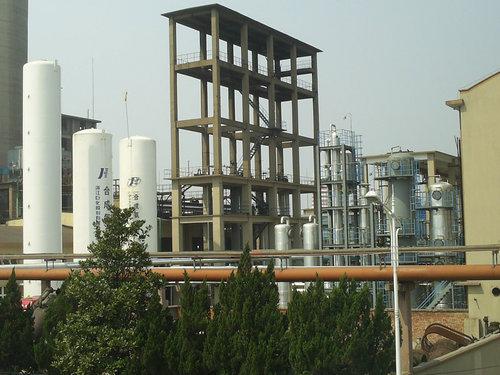
Zhejiang Jinju Chemical Co., Ltd. is a company with many years of experience in the production of food-grade CO2. It currently operates two food-grade CO2 production lines, No. 1 and No. 2, each with a design capacity of 30kt/a, for a total annual capacity of 60,000 metric tons. The existing No. 1 food-grade CO₂ unit was retrofitted and put into operation in April 2008. It utilized patented technologies provided by Hangzhou Kuai Kai, including a dehydrocarbonization reactor and Huashuo THC-1 dehydrocarbonization catalyst, and operated stably until July 2011, for a total of 3 years and 4 months. The No. 2 food-grade CO₂ unit was commissioned in December 2006. It also utilized the dehydrocarbonation reactor and Huashuo THC-1 dehydrocarbonation catalyst provided by Hangzhou Kuai Kai Company, operating stably until February 2011 for a total of 4 years and 2 months. Both units met food-grade carbon dioxide standards (GB10621-2006, International Soft Drink Association (ISBT) standards, and corporate standards of Coca-Cola and PepsiCo), and in March 2007, the company successfully became a supplier of food-grade carbon dioxide to Coca-Cola and other companies.
In March 2011, Jinju Company retrofitted the dehydrocarbonation reactor of its No. 2 food-grade CO₂ unit, adopting a reactor from a certain institution and Huashuo THC-2 dehydrocarbonation catalyst. After several months of using the dehydrocarbonation catalyst, the quality of the CO₂ product fluctuated significantly, and it occasionally failed to meet standards. In July 2011, Jinju Company replaced the dehydrocarbonization catalyst in its No. 1 food-grade CO₂ unit with a catalyst developed by a certain institute of the Chinese Academy of Sciences. After four months of commissioning and operation, the catalyst’s hotspot temperature was raised to 530°C, but product quality still failed to meet standards.
Jinju Company’s leadership placed great importance on product quality. In December 2011, they invited technical personnel from Hangzhou Kuai Kai Company and Huashuo Technology to conduct detailed and in-depth discussions regarding the issues encountered in the No. 1 and No. 2 food-grade CO₂ units, ultimately reaching a consensus. Based on the actual situation, Jinju Company decided to replace the dehydrogenation reactors and dehydrogenation catalysts in both the No. 1 and No. 2 systems.
System No. 1 continued to use the original dehydrocarbonization reactor from Hangzhou Kuai Kai, employing the THC-2 dehydrocarbonization catalyst provided by Huashuo Technology. The system was optimized accordingly, and stricter operational requirements were implemented. Temperature ramp-up and activation began on December 22, 2011. The entire activation process strictly followed the THC-2 food-grade CO₂ dehydrocarbonization catalyst temperature ramp-up and activation protocol. Normal production resumed on the 24th, with the hot spot temperature of the dehydrocarbonization catalyst controlled at 425±5°C. According to analysis by the Total Hydrocarbons Analyzer in the Quality Inspection Department of Jinju Company, the total hydrocarbons at the dehydrocarbonization outlet were <1 ppm, and benzene was <5 ppb (the detection limit of the test tube is 5 ppb); the online analysis of total hydrocarbons at the dehydrocarbonization outlet showed <1 ppm, and benzene was <5 ppb. The unit has been operating stably for two months, with the hot spot temperature of the dehydrocarbonization catalyst still maintained at 425±5°C. The total hydrocarbon and benzene levels at the outlet show no significant changes compared to the start-up phase.
The No. 2 food-grade CO₂ unit, which reverted to using Hangzhou Kuai Kai’s dehydrocarbonization reactor (new model) and THC-2 catalyst, started up on February 14, 2012. On the 15th, the THC-2 catalyst began heating and activation; activation was completed on the 17th, with the hot spot temperature controlled at 425±5°C, and the unit transitioned to normal production. Online analysis at the dehydrocarbonizer outlet showed total hydrocarbons <1 ppm. Analysis by the Quality Inspection Department’s total hydrocarbon analyzer confirmed total hydrocarbons <2 ppm and benzene <5 ppb at the outlet, with stable operation.
Through the retrofitting and optimization of the two food-grade CO₂ units, the previously passive situation was completely reversed, achieving ideal results. Product quality is stable and has been well received by customers.
Contact Us
Address:South of 18th Floor, New Oriental International Technology Center, 567 Jiangling Road, Binjiang District, Hangzhou City

Phone:+86-571-87177512 87177550 87177513

Email:hangzhoukuaikai@vip.163.com

Fax:0571-87177570
Quick Navigation

Browse the mobile website